
Archery Elk Prep…Suggestions from a Guide
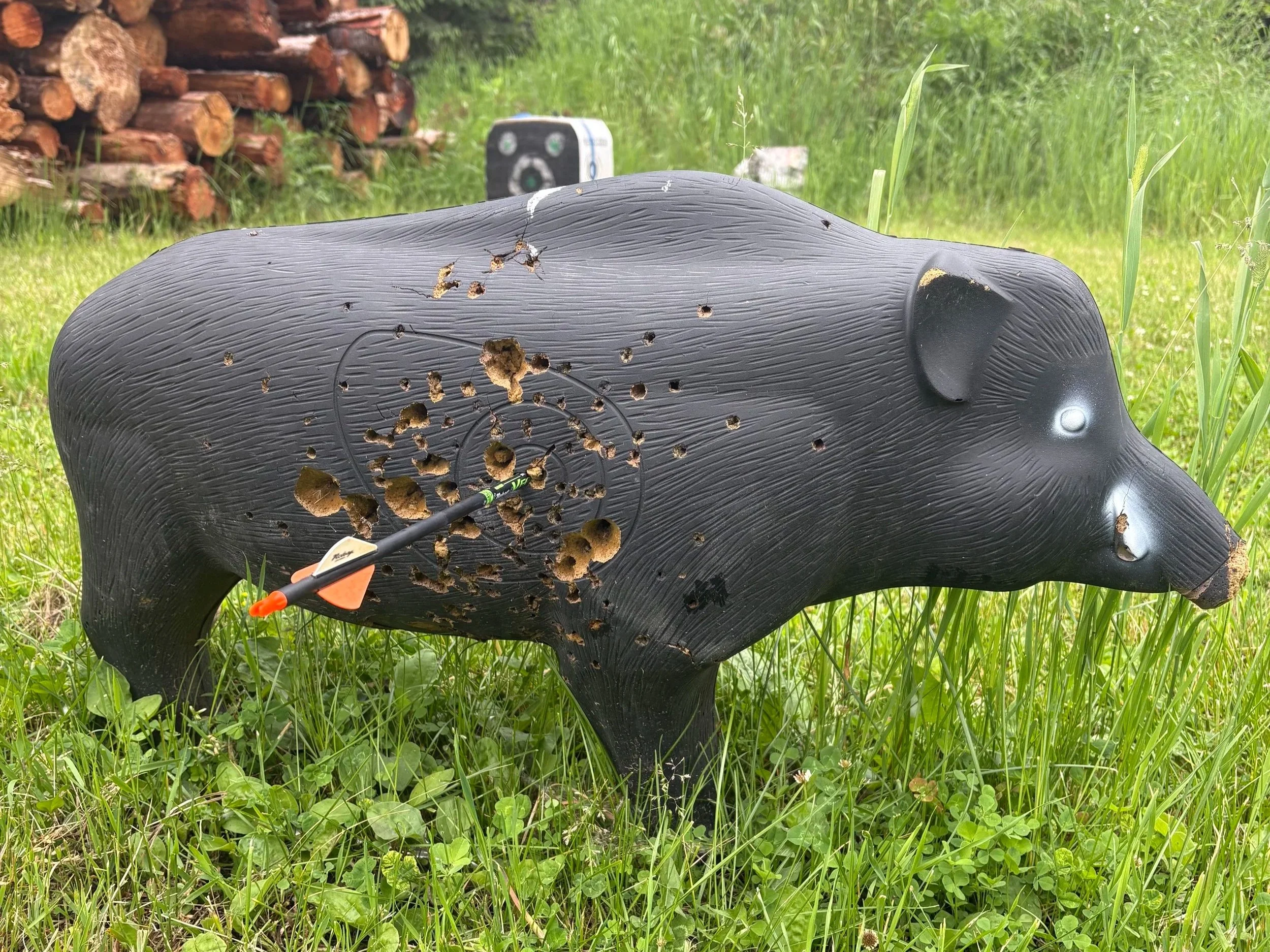
While I’ve had this update planned for a bit I just noticed Remi Warren wrote a similar feature in Bugle, which is the publication for the Rocky Mountain Elk Foundation. So my apologies for appearing to ride on Remi’s coattails a little bit here.
Regardless, in looking ahead to the magical month of September, I wanted to share a few specifics about shooting your bow and preparing for that opportunity on an elk if you’re so lucky when you’re in the September woods. These are a few pointers I’d pass along to any bowhunter, novice or experienced, as they’re dialing their archery gear during the spring and summer months leading up to their actual hunt. These suggestions are based on the notion your bow is already properly tuned.
Please keep in mind I’m not an archery technician and I’m not the best archery elk hunter in the world…I still make tons of mistakes out there. But I’ve guided my fair share of successful (and unsuccessful) archery hunts, again, with both novice and experienced hunters, and I think there’s a few helpful things to pass along to make your practice and preparation as worthwhile and relatable to the actual hunt as possible. So, in no particular order, here’s some food for thought as you begin getting ready for your archery elk hunt:
1) Make sure you’re practicing the right way. Like anything, you can practice and practice and put in hours and hours of repetition…but if your form is incorrect or you’re doing something wrong, you’re simply spending time practicing and instilling bad habits. Bad habits that come to mind to check yourself on: sweeping your bow up as you draw, making a big movement. Punching your string release instead of pressing it slowly so it surprises you when it goes off. Gripping your bow handle in a death grip at full draw thereby producing accidental torque on the bow instead of relaxing your bow hand. If you have access to one, stop in at an archery shop and ask one of the techs to watch you shoot a few times to see if they notice anything. Take advantage of their knowledge and skill.
2) Be conscious of your shot sequence. Help yourself stay present by talking through your sequence in your head, whispering to yourself or even talking out loud. Verbalizing your shot sequence can help you stay present and focused. For example, when shooting a compound bow you might say something like this: “I’m drawing my bow. I’m anchored and holding against my back wall. My bubble is level. I’m lining up my pin and peep. I’m on my target and still anchored. Now I’m going to shoot…I’m applying pressure to my release…I’m applying pressure to my release…” and the arrow is loosed. Try it.
3) Distance. At Dark Timber Outfitters, we adhere to a policy of no shots beyond 40 yards unless a couple specific exceptions are in play. However, when you’re practicing at home or at the archery range, it’s definitely worth practicing 50- or 60-yard shots. Or further if you want to. Practicing at these longer distances can help your shooting form, your breathing routine, and makes your 20- and 30-yard shots seem like chip shots which can boost confidence in your shooting ability.
4) Change up your practice routine. Shooting 20 or 30 or however many arrows a day is great for developing muscle memory. Muscle memory can be extremely helpful when you’ve got adrenaline dumping into your system as an elk approaches and you prepare for a shot. I’ve had countless bowhunters say they don’t remember anything from their shot other than drawing…it’s like they black out. This is where muscle memory hopefully saves the day. However, standing at the same distances and shooting the same targets over and over can result in complacency and your brain to go on auto-pilot. You’re not necessarily in the moment with each shot when that’s your practice regimen. So change it up. Move your target(s) around so you’re forced to rethink your distances. Practice estimating distances and shooting without a range finder. Go to some public land and shoot judo tips at rotten stumps or logs or grass seed heads or random things on the forest floor (just make sure you’re being safe and not shooting into rocks or something where you won’t be able to retrieve your arrow!).
5) Make shooting realistic and challenging. Sometimes a shot on an elk works out like a dream and everything is perfect from a shooting position standpoint. But often times it doesn’t play out that way. So take this into account when you practice. Shoot with most of your weight on one foot. Then shift your weight and shoot off the other foot. Shoot from your knees. Shoot off one knee. Set your feet so your body is unnaturally twisted in relation to the target and shoot. Then set your feet 180 degrees the other direction and do the same thing. Build a little ramp, stand on it and shoot so you’re comfortable with your feet being on an uphill or downhill slope. If you can do so safely, shoot from your roof down into a target. If you have the ability to safely shoot uphill at a target, practice that. Elk don’t live in flat terrain and arrows fly differently when shooting at uphill or downhill angles. Run for a total of 100 yards, immediately grab your bow, nock an arrow and shoot. Do this 5 times. This is a great way to simulate the elevated heart rate you’ll experience when an elk comes in. Practice with a friend or two and have them stand literally right behind you when you shoot. This is a great way to simulate the pressure you’ll experience when an elk comes in.
6) Treat your practice like the hunt. Envision a bull coming in when you’re practicing. Visualize yourself making an ethical, lethal shot. Get your bow up in front of you and go through your shot sequence as if an elk were coming in. Practice holding your bow at full draw for 30 seconds before you shoot. Then for 60 seconds before you shoot. Then for 90 seconds…two minutes even. In real life, that bull may come into range…and then stop, just 25 yards away. And you’re at full draw, you can’t move and you need that bull to take one…more…step because there’s a tree in the way. But he’s in no hurry. Training your muscles to hold and hold and hold at full draw until the right shot presents itself is super important. Practice delivering an accurate and soft mew or cow call from a diaphragm call while at full draw to simulate getting that bull to stop where you want him to. And every now and then, shoot with the same gear on as you’ll be hunting with. Make sure you shoot a few times wearing your boots, baseball cap, your binocular harness, backpack. Discovering your bowstring catches the sleeve of your hunting jacket or that wearing your backpack makes it really hard to reach full draw when a real-life bull is coming in on the trot is not a good time for these discoveries.
7) One arrow. A last suggestion I’ll put out there is to practice shooting just one arrow. We tend to shoot a bunch of arrows when we go out to practice, which is great and if we make a bad shot, we know we can just shoot again and correct the prior shooting mistake. But you don’t get 20 shots at an elk. You usually get one shot, maybe two on a rare occasion. So once or twice a week as September draws closer, make your practice session consist of just one shot. That’s it. One shot and you put your bow away until the next day. On that one shot, visualize a hunt playing out in your mind, incorporating one or more of the scenarios I’ve touched on above like standing on a slope and having to hold at full draw for 73 seconds. Or drawing your bow and pretend to follow an elk, sweeping your bow left to right with the imaginary walking elk, cow calling it to stop and then shooting your target. Stuff like that. Make it fun, make it as realistic as you can but only give yourself that one arrow.
I’ll stop there. Everything I’ve tried to relay in these 7 topics stems from what I’ve seen on archery hunts I’ve guided. My goal is to help you be as prepared and ready for that elk encounter as you can be. Hopefully you’re able to practice some of these suggestions and I hope it’s beneficial. As always, if you have any questions, please let me know.
Thank you for taking the time to read this and talk to you soon……Adam